
By following these instructions on how to trace your horse’s back, we can find the best saddle tree match for your horse, which in turn saves you a lot of money in wasted shipping costs and frustration.
Items you will need:
Your horse.
Level ground.
A helper to hold your horse square with its head straight.
A minimum 24” Flexi Curve or Flex Ruler (Amazon has them for less than $10).
Manila/file folder or 8.5”x14” piece of paper.
A Sharpie or Marker.
Straight ruler with inches or centimeters (preferred).
Cell Phone/Camera.
Stool/Step Ladder.
Pieces of tape or chalk.
How to take a tracing of your horse’s back:
Lay your manila/file folder open on the ground or table near your horse.
Write your horse’s name, current date, approximate weight and height for future reference along with “left” on the left side and “right” on the right side of the folder.
Straighten out the 24” flexi curve/ruler. Mark the center of your ruler with a little mark to help you keep it centered on your horse.
It’s so much easier to have a helper handy for this part. Have your horse on level ground, standing as square as you can get it with no hip relaxed and the head and neck straight. Find the edge of the scapula with your fingers, mark your horse with a piece of tape or chalk three fingers behind the scapula on each side.
Lay your flexi curve/ruler over the top of the tape/chalk and mold it to your horse’s back. Make sure the ruler is on your tape or chalk line on each side of your horse’s back. Keep the center mark in the center of your horse’s back/spine.
Rub rub rub that ruler to make it copy the shape of your horse.
Gently lift the flexi curve/ruler up from the center point, trying hard to keep
the shape and transfer it directly to the manila/file folder, aligning the center of the ruler with the center of the file folder, with the left side of the horse on the left side of the file folder.
Trace the shape of the flexi curve from the underside of the curve (what touched the horse’s fur) to the manila folder.
You might want to repeat steps 4 – 7 to check your work.
Measure 1” back from your tape/chalk and tape/chalk your horse again.
Take a tracing, repeating steps 4 – 7. I find it nice to align all your tracings on the manila folder from the same center-line, stacking them on top of each other. (See photos below).
Again, measure 1” back from your second tape mark and repeat.
Do not worry if your horse is asymmetrical. Most horses have differences from side to side. Knowing this information if very helpful.
Be careful to not to switch your left and right sides when transferring your flexi curve/ruler to the file folder.
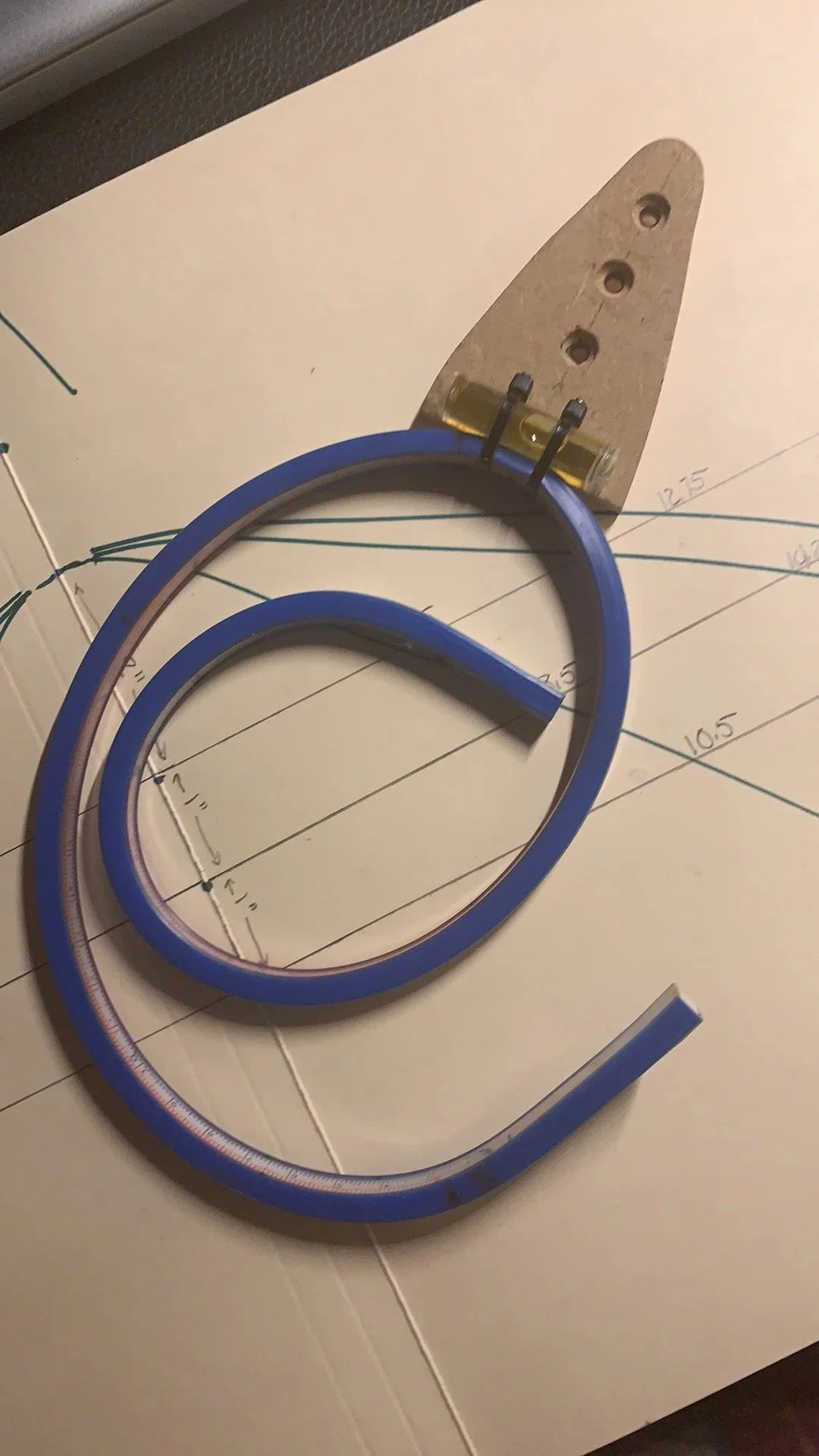
Flex Ruler
Now what?:
From the top of your marks on the file folder, measure down 2” and draw a horizontal line thru all three tracings.
Measure 1” below that line and draw another horizontal line thru all three tracings.
Measure 1” below the second line and draw a third horizontal line thru all three tracings.
From the centerline, measure how many inches or centimeters to the left and to the right where the horizontal line crosses the tracing lines. In the example above, my mare is 8.5cm on the left and 8.5cm on the right, for a total of 17cm across. (Measuring each side helps to show if your horse is asymmetrical or not).
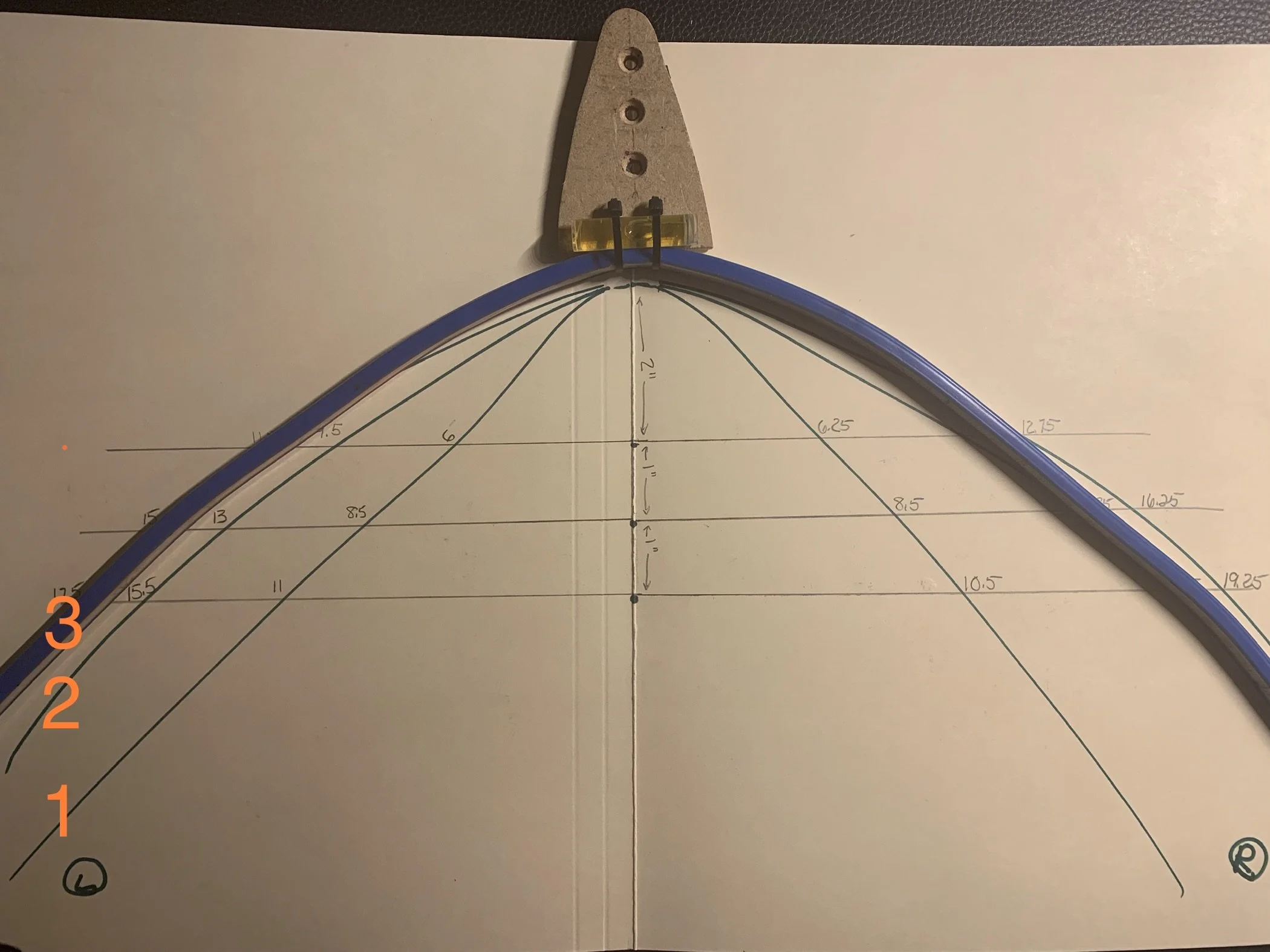
Tracing with measurements in centimeters.
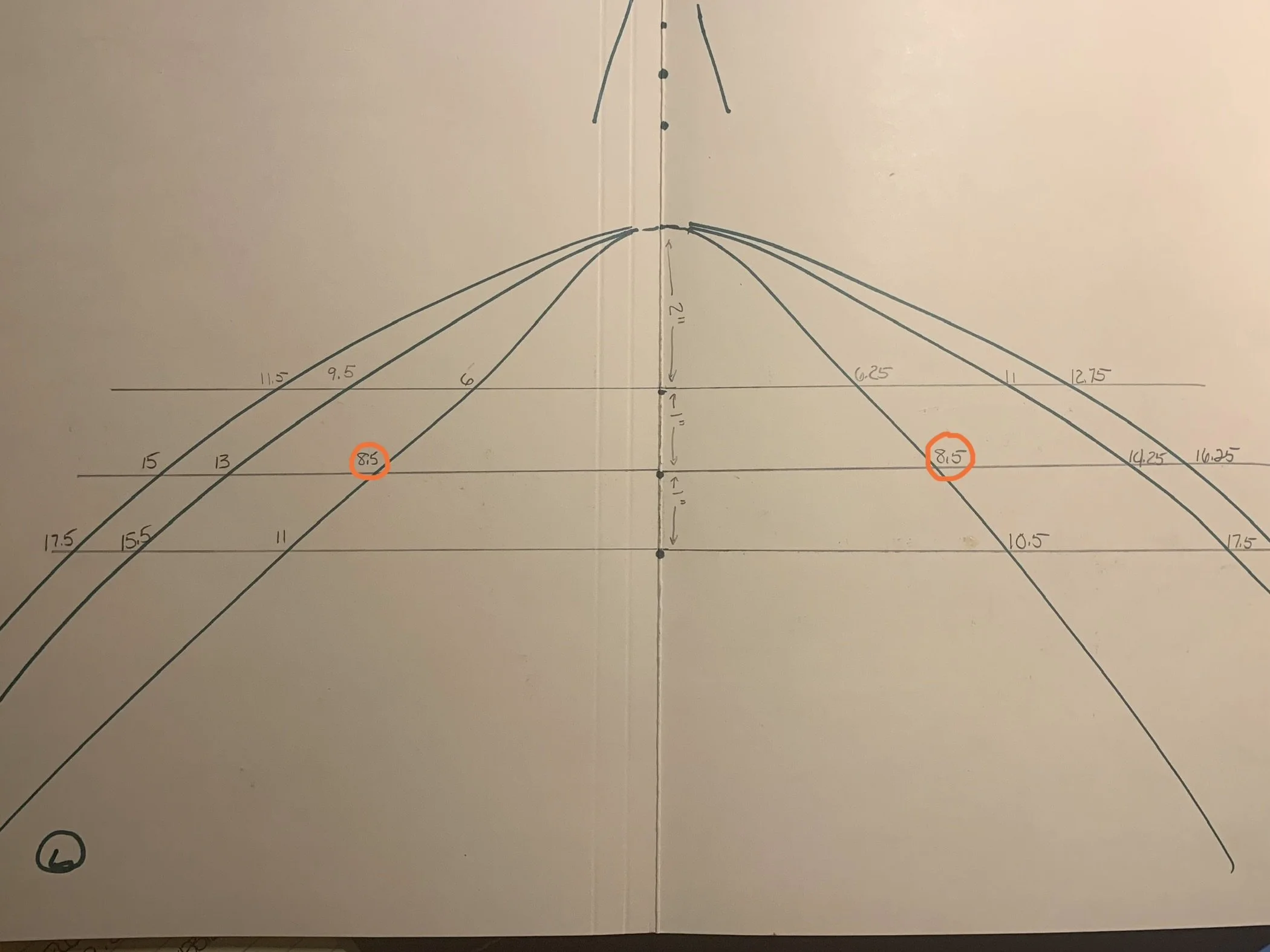
Measurements from the left center line to Tracing 1 is 8.5 cm, from the right of the center line is also 8.5cm, showing he is symmetrical. With a total of 17 cm he fits nicely in a wide tree.
Photos:
It is so helpful to have a helper for this task. Have your horse standing on level ground, standing square, head and neck straight ahead with solid background with good lighting.
Take a photo of the whole horse from the left side without a saddle or blanket. Take the photo level to its body, in the middle of the horse.
Take a photo of the horse from the back looking down on its back, showing its shoulders. Make sure the head and neck are straight and the horse is square with all four feet weighted. No relaxed hips. BE VERY CAREFUL, THIS CAN PUT YOU IN A DANGEROUS POSITION BEHIND YOUR HORSE.
Photo of rider with weight and height is also helpful.
Measurements:
Sit on a chair with your bum all the way to the back of the chair, with your knees bent at a 90º angle. Measure from the back of the chair (back of your bum) to the front of your knee.
Measurement: _____________________
Inseam: ___________________ Pant size: _______________________
Height: ___________________ Weight: _________________________